A ticket selling obligation is a bad idea – because of UX

Today the European Commission released the proposal for a new rail ticketing regulation. Rail commentator Jon Worth calls it "radical and unworkable". In this post, I want to reinforce that point, focusing on the ticket selling obligation for operators (Article 5).
It thus contains an obligation for state incumbent railways with significant market share (e.g. Deutsche Bahn, SBB, SNCF, etc.) to sell tickets for all other operators doing business on their territory.
While this sounds fair at first glance and the only right thing to do, there's something the European Commission did not take into account. And it will most likely result in the opposite of what was intended.
The idea of obliging state railways to also sell tickets from their competitors is mostly justified with existing behavioural patterns of passengers. When it comes to international trains – unlike with planes – people first and foremost go to their own incumbent platform (e.g. bahn.de, sncf-connect.com, etc.) to a) inquire and b) purchase train tickets. They are used to doing so because they do it on a regular basis for domestic rides.
But with international train journeys that quickly becomes a huge hassle.
State incumbents often do not even display international train rides from other operators, least sell them. Sometimes they show them in the timetable, but without prices – and without a purchase option. Sometimes people can only buy them at the incumbent's physical selling points or internal travel agencies.
People then resort to Googling or ChatGPTing, most often ending up on third-party platforms like Trainline, Omio or Raileurope, where they often pay a surcharge for their tickets. That surcharge doesn't buy them anything – not even better passenger rights, for one thing.
From this point of view, in a perfect world, it would indeed be nice if you could buy a ticket for any competitor operating on domestic (or even foreign) territory on your favourite state railway ticketshop – at the original price, without surcharge. And it would only be fair that private, open access operators such as European Sleeper or Flixtrain get visibility on a platform that is essentially financed with public money.
It's almost impossible to get the UX right
The devil – as always – lies in the details. Namely in something where the little details are very, very important: user experience (UX).
Rail travel is complex. Unfortunately, the main stakeholders often turn it into something quite complicated.
Think of the different fare options that rail companies have started introducing – flex, reduced, cancellable, Super Saver, etc. Then think of the myriad of subscription cards and loyalty programs every operator maintains – SBB's Halbtax Abo, DB's Bahncard, ÖBB's Vorteilcard, etc. That is one thing.
The next complexity arises from seat categories: In the good old days, there were two classes: 1st and 2nd (well, a while ago, there were usually three classes, but let's not go too much into history). Now we have Premium, Business, etc. Sometimes you need to buy a mandatory seat reservation, sometimes not. Sometimes only on certain routes, e.g. cross-border. Low-cost companies such as the recently started GoVolta charge for additional luggage, taking over a business model from the likes of Easyjet and Ryanair.
Night trains are yet another story. There you have not two, but sometimes up to twenty different categories. This complexity is a reason why I founded nightride.com – especially in this niche, the incumbent operators' platforms do a particularly bad job at displaying the offers in an understandable way. One example being ÖBB, leading the pack in an almost comical incapability of rendering their own offers so that people actually understand what they are going to buy.
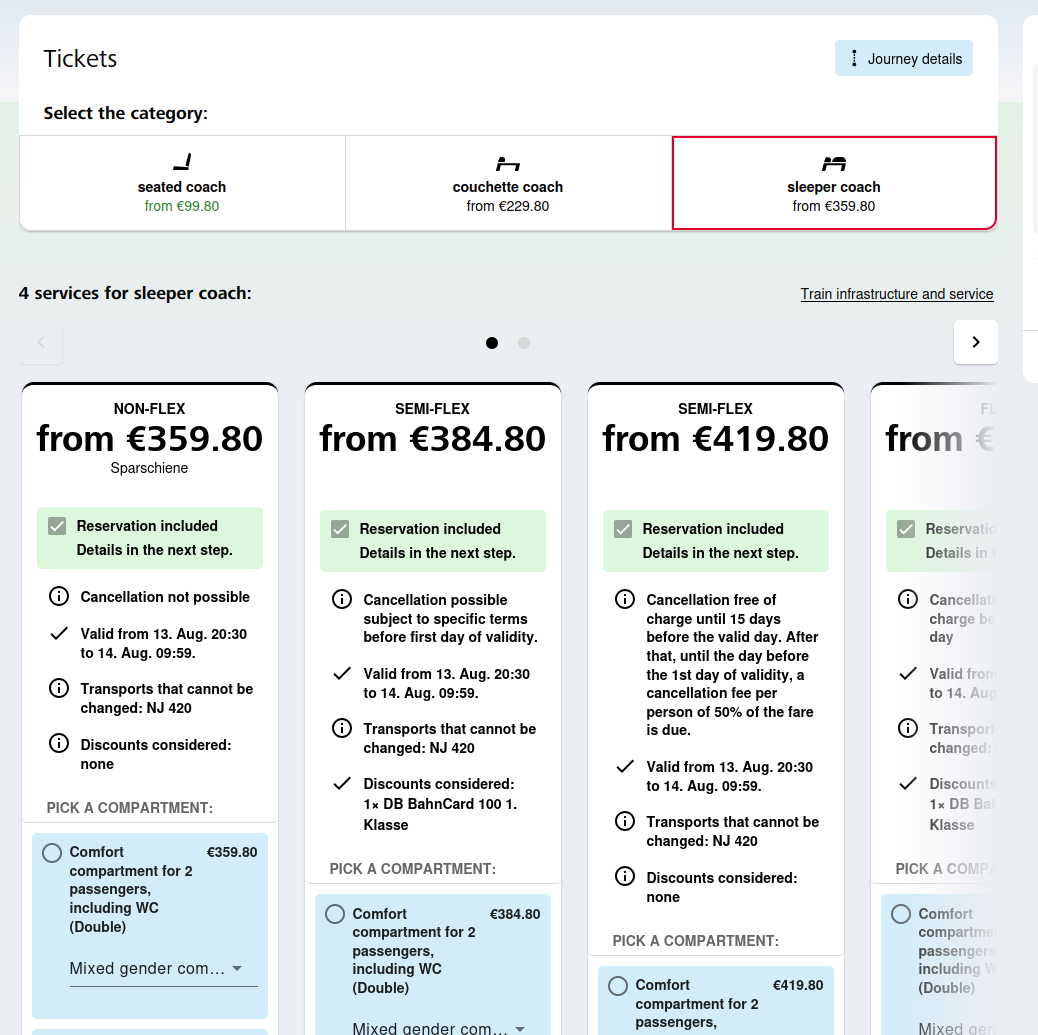
I am sure: They did their very best to render the offers in the most user-friendly way possible. The complexity of their product in combination with both domestic and foreign discount cards is what throws a wrench in their works.
Another example: European Sleeper recently broke out of the Holy Trinity of seaters, couchettes, and sleepers with introducing a fourth category they call "Comfort Standard" – couchettes with actual matresses. Let's say that it didn't make their already convoluted booking flow easier for their customers.
Now, if operators already struggle with UX when it comes to their very own offers, what could possibly go wrong when they are forced to do that for their competitors?
DB Navigator/bahn.de, clearly one of Europe's best travel planning apps, has recently started integrating offers through OSDM (Open Sales & Distribution Model, a technical specification). Notably only from other state incumbents, not from private operators. Their marketing page boasts that you can now book a sleeper train to the very north of Europe – Narvik.
The only problem being that the respective offers – after more than three months of integration – are still incomplete. You can buy a seat (please don't). And you can buy a place in a private compartment in a couchette or in a sleeper car. The shared options are just not displayed. They are not even mentioned. Needless to say that the private options bear a hefty price tag.
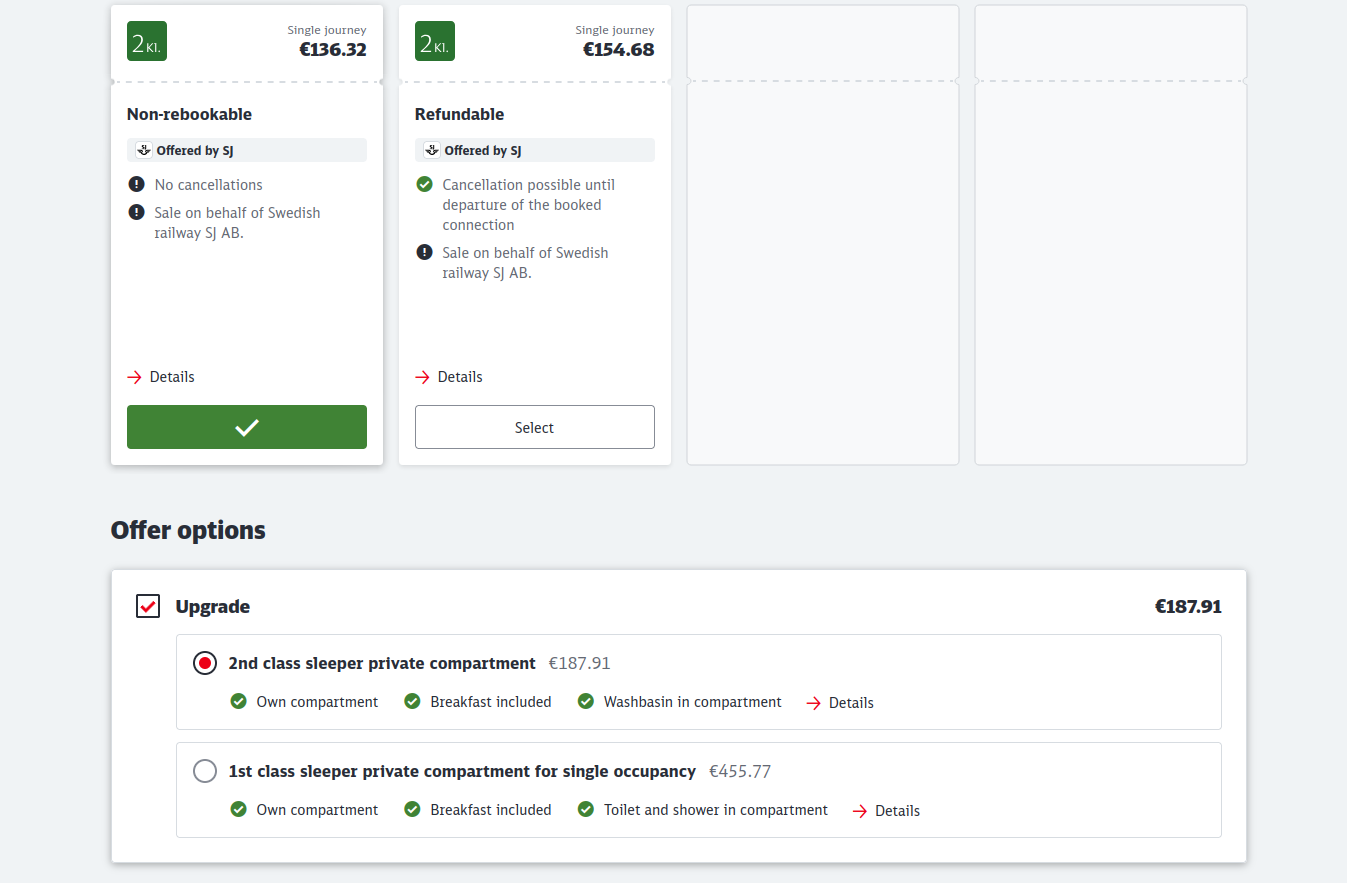
Add to that the design of their shop page for night trains, which is per se... quite confusing. By the way: In case you have missed it in the screenshot above, what is the difference between a private compartment for single occupancy and one without that suffix? 🤡
DB also sells tickets for SNCF night trains, by the way. They don't mention that on their marketing page, but it's true. Only that they exclusively sell seats, not couchettes. 🤷
What do passengers do when they are confronted with such a Kafkaesque mess? Yes, they shut down the lid of their laptop in fury, sleep over it, and book a flight the next morning. Totally understandable.
Apparently, what operators do not understand yet, and what the European Commission also does not understand yet, is the following: It is all about user experience when it comes to buying tickets. And user experience is not only about shiny interfaces and fast responses.
What people really need is efficient, transparent, and fair access to price information (otherwise the market fails, correct, economists?) That encompasses a functional design, completeness, and an understandable abstraction of all the nitty gritties of different fare and seat categories. Nobody cares about the product name for a private sleeper compartment or why it is still called "couchette".
But it needs to be crystal clear which options are available, which are sold out, and what the differences between them are. At one glance.
Let's assume that state incumbents would want to sell tickets of other operators, private or public: With the best will it already requires quite some effort, due to the challenges just outlined. Now imagine if such an integration is to take place against the will of an operator.
Such a scenario will likely make the UX even worse than it is today. Which will ultimately drive away customers from rail, leaving them disappointed and frustrated.
"The (private) operator didn't tell us about this category, so we didn't implement it". "They changed the name and our interface broke down, so we just don't show it anymore". Trust me: This is an IT hell in the making.
The regulation also has good parts, by the way: Forcing operators, both private and public, to actually release their data to third party platforms (like nightride.com) will leave the UX job to the ones who actually excel at it (Article 4 of the regulation).